
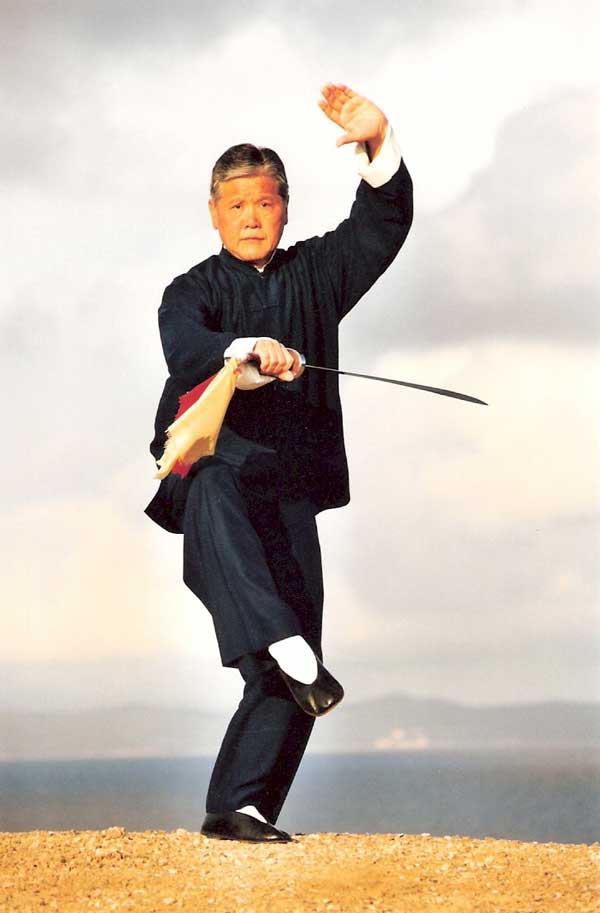
Introduction
Master Tung Kai-Ying (also known as Dong Ji-Ying in Pinyin) is the grandson of Master Tung Ying-Kiai and the eldest son of the eldest son. He was born in Hebei Province under the sign of the Little Dragon. His name, given by his grandfather, can be interpreted as meaning 'He who succeeds the Brave' or 'The continuity of the Brave' - Kai meaning 'to succeed, to continue' and Ying meaning 'brave.'
Early Life
Master Tung Kai-Ying was born into the Tung Family tradition, inheriting the complete Tai Chi Chuan teachings from his grandfather and father. Growing up in a family of masters, he was immersed in the art from a young age, learning not just the movements but the deep principles and philosophy that make the Tung Family style unique.
Founding Schools and Global Teaching
In 1971, Master Tung Kai-Ying founded a school in Los Angeles, California, bringing the Tung Family Tai Chi teachings to the United States. Since then, he has taught extensively throughout the USA and Europe, establishing a global network of students and teachers dedicated to preserving and spreading the authentic Tung Family style.
Teaching Philosophy: Ju Mu San Fen
Master Tung Kai-Ying's philosophy emphasizes 'Ju Mu San Fen' (penetrate an inch deep into the wood). This expression comes from the story of a famous calligrapher, Wang Shi-Zer, who spent so many years writing that the ink of his brush penetrated an inch deep into his table that was made of hard wood. It is used to refer to a student who has studied rigorously and has achieved a high level. Master Tung explains that to reach such a level, one needs patience, dedicated fellow students, and a teacher with great knowledge.
Training Methods
Master Tung Kai-Ying emphasizes three key points in training: attention, concentration, and correct postures. When these three points are observed, quick progress can be made. He teaches that consciousness is the master of all things - when it is present, progress is quick; when it is absent, activity stops. When practicing Tai Chi Chuan, one must elevate one's consciousness.
On Breathing
Master Tung teaches that when breathing occurs naturally, it adapts to all action speeds and all situations. One should not be pretentious. For instance, lowering the Chi to the dantian (a zone below the navel) cannot be reached by force. When you reach a good level, movements foster breathing; enhance breathing and the Chi flows naturally to the dantian zone.
On Tui Shou (Push Hands)
Master Tung explains that to develop sensitivity and understand better how to interpret force, one needs to practice Tui Shou. During the first months, you should not use force. You should practice circular movements with one hand. Then, the four basic methods for pushing the opponent can be learned: Peng, Lu, Ji, An. In China, Tai Chi is sometimes called 'Peng Lu Ji An.' This is how the student learns the art of deflecting pushes, first by using the elbow, then by turning the waist, and finally the shoulder movement so that the opponent's force meets no resistance.
1999 International Celebration
An International Celebration took place in September 1999 in China to celebrate the end of the millennium, with 230 students and teachers of Master Tung Kai-Ying's Academy from California, Colorado, Arizona (USA); Finland, Denmark, Sweden, Italy, Norway, Ireland, Greece, France (Europe); and many Asian countries including Singapore and Thailand. The celebration included workshops, demonstrations, and visits to Beijing, Shijiazhuang, Xingtai, and Renxian - the birthplace and homeland of the Tung family.
Legacy
Master Tung Kai-Ying continues to teach and spread the Tung Family Tai Chi teachings globally. His son, Tung Chen-Wei, has also put on the hard work, continuing the family tradition. The Tung Family style, crafted over several generations of experience and teaching, continues to inspire practitioners who dream of letting a little bit of ink penetrate into their own hard wood - achieving that deep level of understanding and mastery.