
Early Life and Origins
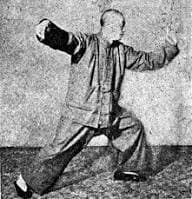
Tung Ying-Kiai (also known as Dong Yingjie, Tung Ying-Kit, or Dong Ying-Jie) was born on November 8, 1897, in Renze (then known as Renxian), Xingtai, Hebei Province, China. His given name was Wenke (文科). He came from a peasant family that ran a coaching inn in the big village of Xingtai, in Renxian County, about 400 km south of Beijing. The family inn was described by his grandson as 'a bit like in Western movies! One would stop there to feed horses, eat and sleep.'
Early Training and Determination
Despite frail health in his youth, Tung Ying-Kiai was attracted to the art of Tai Chi Chuan very early on. When a visitor to the family asked about his aspirations, the very young Tung Ying-Kiai answered that he wished 'to become a martial artist, improve his health, be able to defend himself and make Tai Chi Chuan known around the world.' The visitor, Liu Ying-Zhou, who admired very much this determination, was an expert and a friend of Yang Lao-Zhen. Thus, he taught Tung Ying-Kiai the basics. Since he was himself an old man, he asked another disciple of Yang Lao-Zhen, Li Zeng-Kui, to help him in this task.
Training in Wu/Hao Style
One year later, Liu took Tung to Huining, to visit Master Li Xiang-Yuan (Bao-Yui), a very discrete student of Hao Weizhen (also known as Guo Wei-Zheng). Master Li taught Tung the 'Kai He' Tai Chi: a style called 'hard' or 'open and closed.' This style is part of the Wu/Hao school, founded in the early 19th century in Guangfu, in Yongnian County, by Wu Yuxiang who created it from an old set of the Chen family. Before accepting him as a student, Master Li asked Tung for a demonstration. He nodded, then did some partner exercises with this new student. In order to show him an application, he hurt his arm deep into the bone using only one finger, which instilled great admiration from his new recruit!
Disciple of Yang Cheng-Fu
Since he admired very much the Yang family, which in those days lived in Beijing, he went there to study. People tried to discourage him, telling him that Yang only taught his Kung Fu to family members. To this, Tung answered: 'Determination can move heaven and earth. Sword bearing knights, men of arms of the old days, treated with regard and great respect their teachers in order to learn their art. It is not impossible to learn if you treat them well. I shall do all that is in my power to learn from Master Yang.' Yang Cheng-Fu was the greatest Tai Chi Master in those times. He immediately accepted Tung as disciple in Beijing, who soon became an assistant, then a friend. Tung trained assiduously, from morning to evening. When Yang travelled to the south, he always asked Tung to come along. They travelled in different regions of China, where they were invited by the Province authorities. They taught together in Nanking, Shanghai, Hangzhou, Suzhou and in many other historical or beautiful places.
Co-Authoring with Yang Cheng-Fu
Tung and Yang co-authored Yang's last book: 'Tai Chi Chuan applications' (太極拳使用法), published in Shanghai. Their friendship lasted more than 17 years, until the death of the one who was called 'The Venerable.' Both Tung and Yang Sau-Chung (or Shou-Zhong), the eldest son of Yang, officially inherited the style. Tung had gained quite a lot of experience; he stayed some time in Canton, then left the country in which he was born for Hong Kong after the outbreak of the Sino-Japanese war.
Legacy
Master Tung Ying-Kiai established the Tung Family Tai Chi lineage, which has become one of the two most famous lineages for the transmission of the Yang style, alongside the Yang family itself. His teachings have been passed down through his son, Tung Hu-Ling, and grandson, Tung Kai-Ying, spreading Tai Chi Chuan globally. The Tung family has maintained its originality while preserving the authentic Yang style teachings.